

Select your language


Antonio José Fernández, universally known in Venezuelan art as “El Hombre del Anillo” (The Man with the Ring), was born on September 8, 1922, in the village of El Corozo, in the Escuque district of Trujillo state, Venezuela. The son of Ramón Fernández, a bricklayer, and Ana María Franco, he was a self-taught artist with no formal academic training. In his youth he worked in agriculture, sowing vegetables, and in 1940 he entered compulsory military service at the Bolívar barracks in Táchira, where he learned nursing, a trade he later practiced. In 1948 he set up a fruit stall in the market of Valera, and it was there that he began to be known by the nickname that would accompany him forever, on account of a large ring carved from river stone that he wore on his right hand and had made himself.
Fernández's artistic path was gradual and marked by hardship. He made his first sculpture in 1949, a piece titled La Maternidad, which received little acceptance and even provoked mockery from some of his neighbors. From 1952 he began producing sculptures under the influence of the Trujillo artist Salvador Valero, working by casting cement or carving wood. In 1958 his work came to the attention of the physician, poet, and painter Carlos Contramaestre, who mentioned him in an article in El Nacional. In 1962 he temporarily abandoned his work in wood and canvas to experiment with plaster, but in 1963, discouraged by the ridicule of his neighbors and by the rejection of a piece he had offered to donate to a local secondary school, he destroyed the works he had produced up to that point and gave up artistic activity altogether; it was Salvador Valero who encouraged him to continue. Fernández then entered a monumentalist phase, creating large-scale figures for fountains and gardens, and he came to prefer polychromy, which helped him define his typologies.
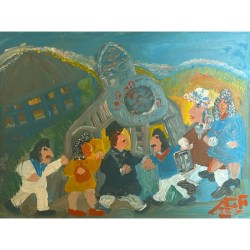
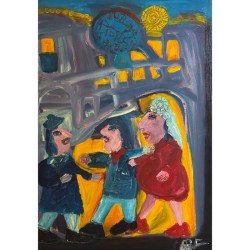
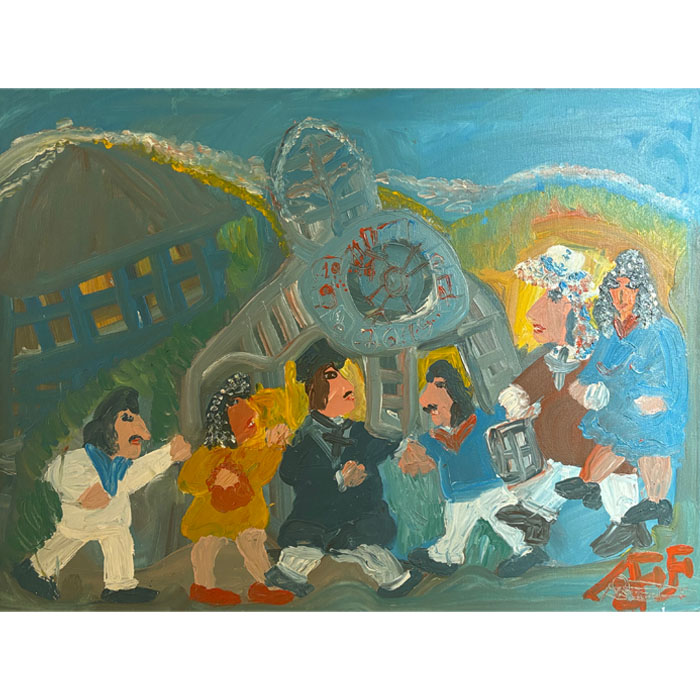
His public recognition arrived in 1965, when Carlos Contramaestre organized his first exhibition at the Galería El Techo de la Ballena in Caracas, a show that attracted the interest of specialized critics. The painter and poet Juan Calzadilla celebrated him as “the first naive sculptor to appear in Venezuelan art,” praising the variety of techniques and materials he employed, including stone carving, wood carving, cement casting, polychromy applied to relief and freestanding figures, collage, canvas, and cardboard. His work evoked peasant life, his surroundings, nature, animals, and Christian myths, creating a symbiosis between sculpture and painting through a highly personal language that drew the curiosity of critics such as Sofía Imber and international cultural figures such as the American novelist William Styron, who visited him in his room in Carvajal. Further exhibitions followed at the Galería XX2 in 1967 and at the Galería Ángel Boscán and the Galería de la Universidad Central de Venezuela in 1968, among many others.
In the later decades of his life, Fernández received numerous honors, including the Conac Prize at the Salón de Arte Popular Fundarte in 1985, the Premio Casa Guipuzcoana in La Guaira, the Bárbaro Rivas Prize at the IV Bienal Bárbaro Rivas in 1994, and the Premio Nacional de Cultura Popular in 1998. In 1997 he was also awarded the Premio Nacional de Arte Popular “Aquiles Nazoa”. Despite this recognition, he lived much of his life in extreme poverty, and only in his final years was able to partially meet his needs; ironically, his works today sell for between one and two thousand dollars in the art market. He spent more than three decades in a modest house in Carvajal, lent to him by his friend José “Pepe” D'albensio, which served as his home, workshop, and exhibition space. Antonio José Fernández died in Valera on January 5, 2006. His legacy endures as one of the central figures of Venezuelan popular and naive art, and a distinction of the Bienal Nacional Salvador Valero bears his name.

We have access to a wide range of art collections to meet your requirements, ranging from Venezuelan & Latin American to international masters.
Contact us at +1 305 907-9960 regarding the artist you’re looking for; we’ll search and find it for you.
When starting a collection one must consider a variety of factors. First however, one must start by asking – why and how will I start to collect art?
 Sombras de Crítica