



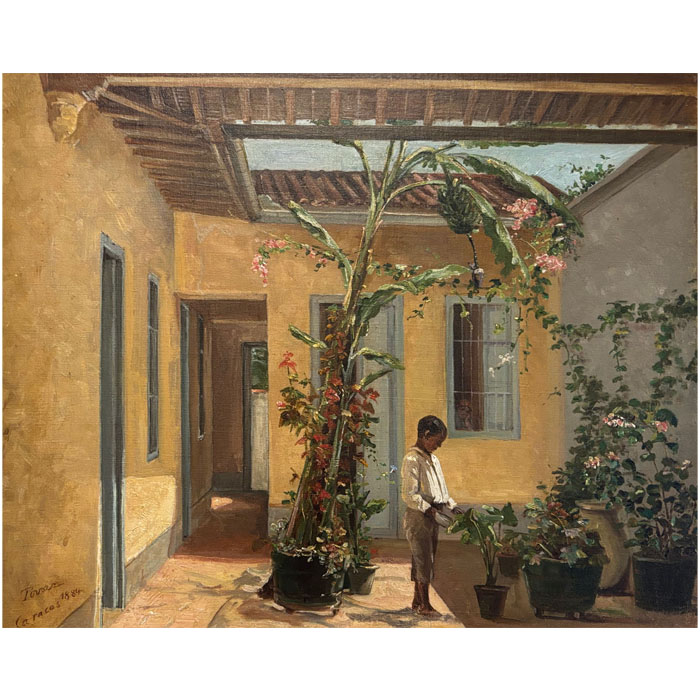
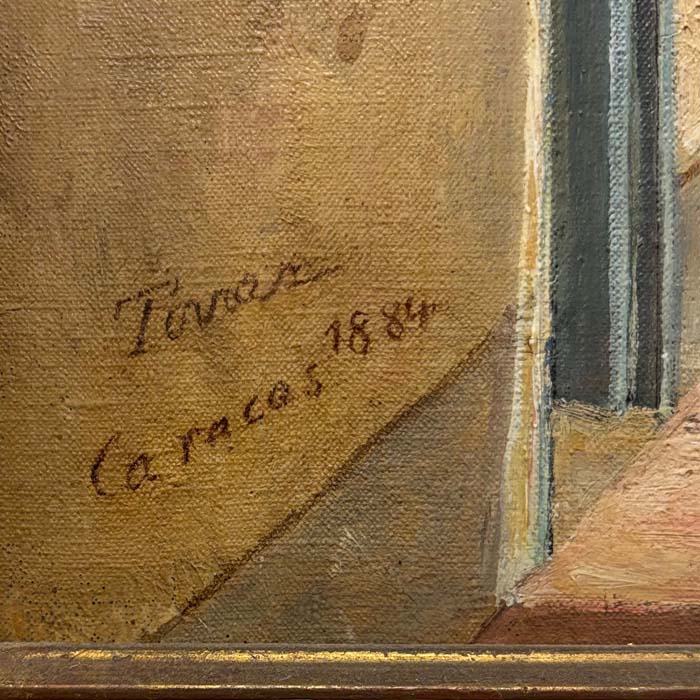


Martín Tovar y Tovar (1827–1902) is widely regarded as the most influential figure in 19th-century Venezuelan art, primarily for his role in establishing a visual identity for the young republic. Born in Caracas, he began his training under Carmelo Fernández before moving to Europe in 1850. His formative years were spent at the Real Academia de Bellas Artes de San Fernando in Madrid, studying under José and Federico de Madrazo, and later in Paris at the workshop of Léon Cogniet. This European education provided him with the technical rigor of Neoclassicism and Romanticism, which he would later use to document Venezuela's most epic historical moments.
Beyond his skill as a painter, Tovar y Tovar was a visionary of cultural infrastructure. In 1865, he founded one of the first professional photography studios in Caracas, "Fotografía Artística," demonstrating an early interest in modern visual technology. He also served as the director of the Academy of Fine Arts in Caracas, influencing a new generation of artists. His commitment to the state led him to propose the creation of a National Museum, and although the project faced financial hurdles, it laid the conceptual groundwork for future national institutions like the Galería de Arte Nacional (GAN).
His most enduring legacy is the monumental series of commissions for the Salón Elíptico of the Federal Legislative Palace in Caracas. Between 1873 and 1888, under the patronage of Antonio Guzmán Blanco, he produced a gallery of independence heroes and his magnum opus: The Signing of the Independence Act (1883). This was followed by his massive mural for the dome of the Federal Capitol, depicting the Battle of Carabobo (1887), a work covering approximately 458 m2. These paintings transformed the seat of government into a national pantheon, solidifying the iconography of the Venezuelan independence struggle.
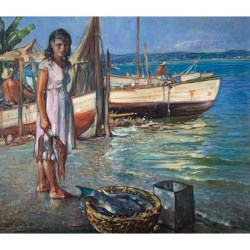
In his final decades, Tovar y Tovar shifted from the grandiosity of historical scenes to the intimate study of nature. He became a pioneer of Venezuelan landscape painting, focusing on the Macuto coastline and the Caracas valley. This transition from rigid academicism to a more fluid, atmospheric style served as a vital bridge to the Círculo de Bellas Artes, the movement that would later modernize Venezuelan art. He passed away in Caracas in 1902, and in 1983, his remains were moved to the National Pantheon, an honor reflecting his status as the "Painter of the Nation."
We have access to a wide range of art collections to meet your requirements, ranging from Venezuelan & Latin American to international masters.
Contact us at +1 305 907-9960 regarding the artist you’re looking for; we’ll search and find it for you.
When starting a collection one must consider a variety of factors. First however, one must start by asking – why and how will I start to collect art?