

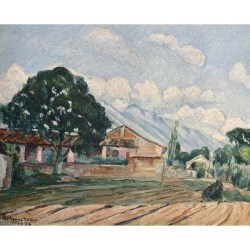
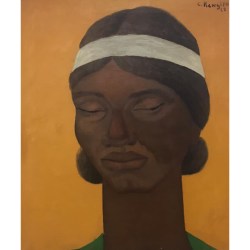
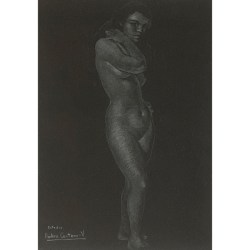
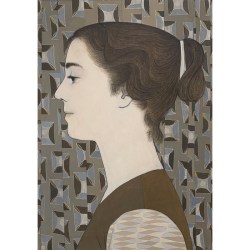


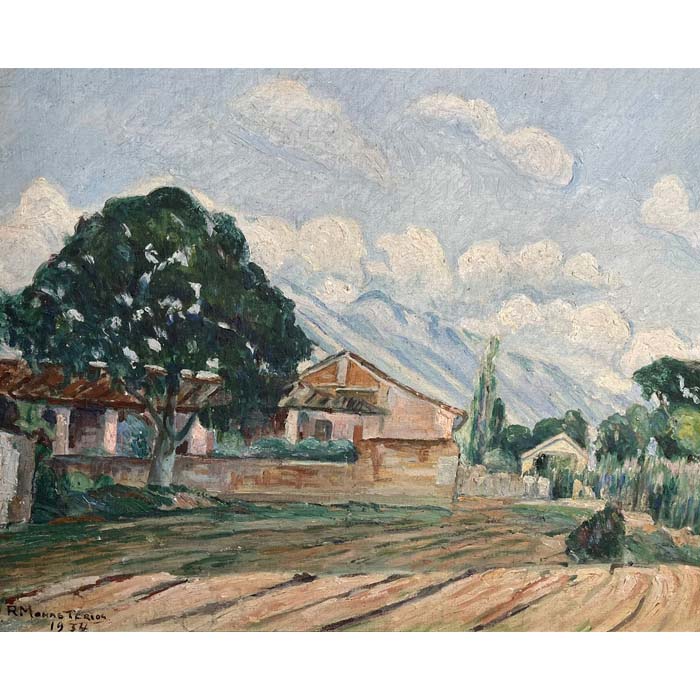
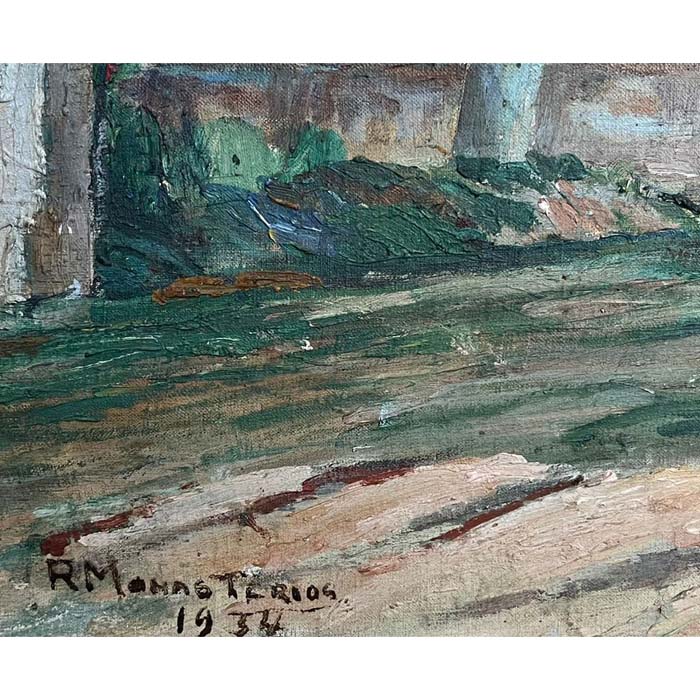


Rafael Monasterios was born on November 22, 1884, in Barquisimeto, Venezuela, and would become one of the most significant landscape painters of 20th-century Venezuelan art. His artistic talent emerged early; at just seven years old, he received his first drawing and painting lessons from artist Eliécer Ugel, arranged by the priest Juan Pablo Wohnsiedler, who took charge of his education after the death of his father, the draftsman Pedro Monasterios. As a young man, his life was varied and unsettled. In 1901, he joined the Libertadora Revolution against the government of Cipriano Castro, but illness forced him to return to Barquisimeto, where he resumed his artistic training. By 1908, with a state government scholarship, he moved to Caracas to enroll at the Academy of Fine Arts, studying under masters such as Antonio Herrera Toro.
Monasterios's formative years included a crucial period in Europe. Between 1910 and 1913, he studied at the School of Arts and Crafts in Barcelona, Spain, where he crossed paths with Armando Reverón, another giant of Venezuelan painting. During this time, he absorbed the techniques of new artistic trends and the influences of Spanish masters like Zuloaga, Sorolla, and Regoyos, which would later surface in his work. He even sent a painting back to Venezuela for the First Annual Salon of the Círculo de Bellas Artes in 1913, which was described by critic Leoncio Martínez as a "light, confused landscape stain". The outbreak of World War I prompted his return to Venezuela in 1914.
Upon his return, Monasterios settled in Barquisimeto and took on various jobs to survive, including painting walls, furniture, and even the dome of the church in Cabudare. By 1917, he had moved to Caracas and became associated with the Círculo de Bellas Artes, a key intellectual and artistic group that championed an Impressionist style and helped pave the way for modern art in Venezuela. Within this circle, he worked alongside peers like Reverón and Manuel Cabré, painting outdoors and developing his distinct approach to capturing light and the Venezuelan landscape. His first individual exhibition took place in 1927 at the Club Venezuela in Caracas, marking a significant milestone in his career.
Beyond his painting, Monasterios was a dedicated educator and a recognized master in his field. He held teaching positions at the Academy of Fine Arts in Caracas and, in 1937, founded the School of Fine Arts in Barquisimeto. In 1941, the same year he moved to Maracaibo to direct the School of Fine Arts of Zulia, he received the National Prize for Painting at the Second Official Annual Salon of Venezuelan Art for his work El torreón de Caricuao. He is remembered as a central figure of the Escuela de Caracas and one of the foremost landscape artists in Venezuelan history, celebrated for his poetic and textured depictions of the country's nature and architecture. Rafael Monasterios passed away in his native Barquisimeto on November 2, 1961.
We have access to a wide range of art collections to meet your requirements, ranging from Venezuelan & Latin American to international masters.
Contact us at +1 305 907-9960 regarding the artist you’re looking for; we’ll search and find it for you.
When starting a collection one must consider a variety of factors. First however, one must start by asking – why and how will I start to collect art?