

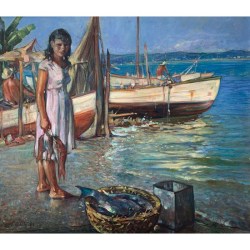
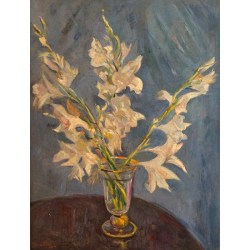
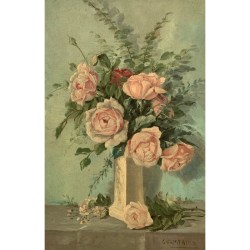
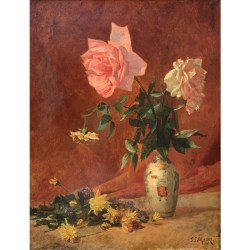


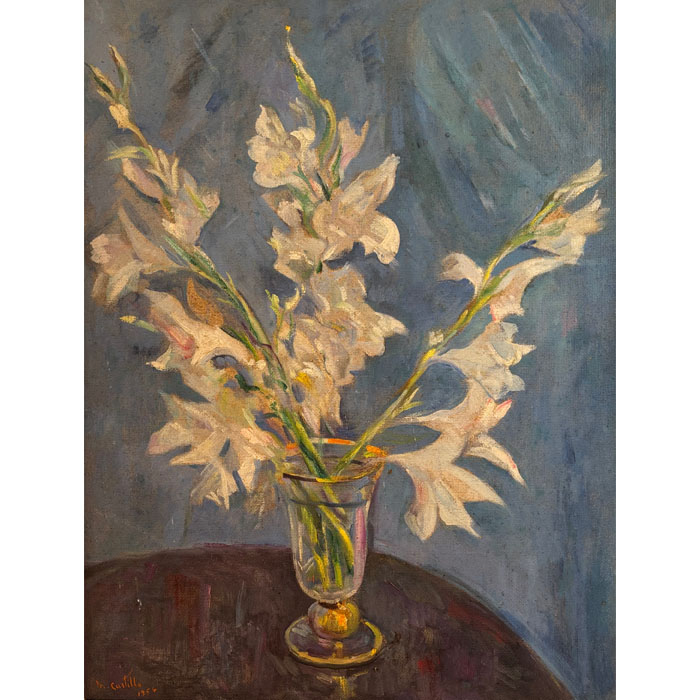
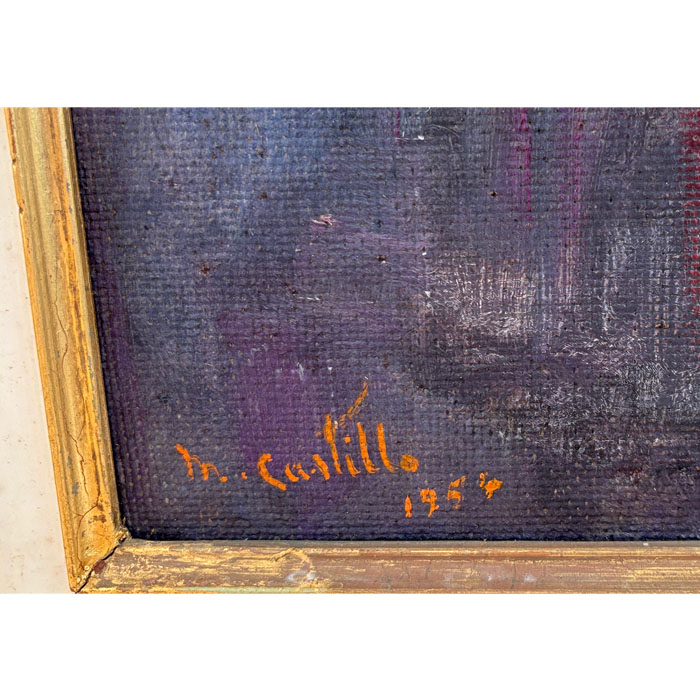


Marcos Castillo was born in Caracas, Venezuela, on April 3, 1897, to Marcos del Castillo and Carmen Rodríguez Álvarez. He demonstrated an early artistic inclination: by the age of thirteen he had already painted a portrait of his mother, and in 1915 he completed thirty-nine anatomical study plates in crayon, charcoal, and pastel on cardboard. In 1916 he continued his training under the Colombian portraitist José Eugenio Montoya, who had studied at the Académie Julian, and in 1917 he entered the Academy of Fine Arts of Caracas, where he took classes in painting, art history, anatomy, composition, drawing, and perspective under Cruz Álvarez García. Early in his apprenticeship he copied works by Cristóbal Rojas and Arturo Michelena, absorbing the academic tradition before moving toward more modern approaches.
Castillo's artistic formation was shaped by a wide range of influences, including Federico Brandt, Manuel Cabré, Nicolás Ferdinandov, Samys Mützner, and Armando Reverón, but the decisive encounter came in 1919 with the visit of Emilio Boggio to Caracas. Castillo attended the exhibition and persuaded Boggio to visit his studio; he later recalled that Boggio "initiated me into the secret of painting and taught me the great technical manners". From 1922 he served as professor of painting and composition at the Academy of Fine Arts, and in 1926 he held his first solo exhibition with fifty-four works at the Club Central in Caracas, followed by a brief trip to Paris. During the following years he studied the work of Paul Cézanne in depth, which left a permanent mark on his approach, and between 1927 and 1928 he signed his paintings under the pseudonym "Maseneth".
Castillo was above all a master of color. As critics have noted, he did not see lines but colors that advance and recede, and like the Post-Impressionists he built form through chromatic harmonies and contrasts, deliberately omitting black from his darker tones. While he worked across all genres—including realistic portraiture—his greatest achievement lay in still lifes, where the compositional strength allowed him to express his passion for color freely. He was also a refined art critic and columnist, writing for Élite, El Universal, and La Esfera between 1930 and 1940. In 1940 he received the National Prize for Painting at the First Official Annual Salon of Venezuelan Art for his work Girasoles, consolidating his position as the most important Venezuelan painter of the moment.
In the later decades of his career, Castillo continued to exhibit regularly, with solo shows at the Museo de Bellas Artes in 1944 and 1950, at the Fundación Eugenio Mendoza in 1957, 1959, 1961, and 1962, and at the Ateneo de Caracas in 1964. He represented Venezuela at the Venice Biennale in 1954 and 1958 and at the Third Hispanic-American Biennial in 1955. An exhibition hall in Caracas was named after him, and his work remains in the collection of the Galería de Arte Nacional, including Girasoles and a self-portrait from around 1955–1957. Marcos Castillo died in Caracas on March 19, 1966, leaving a legacy as one of the great colorists of Venezuelan painting.
We have access to a wide range of art collections to meet your requirements, ranging from Venezuelan & Latin American to international masters.
Contact us at +1 305 907-9960 regarding the artist you’re looking for; we’ll search and find it for you.
When starting a collection one must consider a variety of factors. First however, one must start by asking – why and how will I start to collect art?