

Select your language


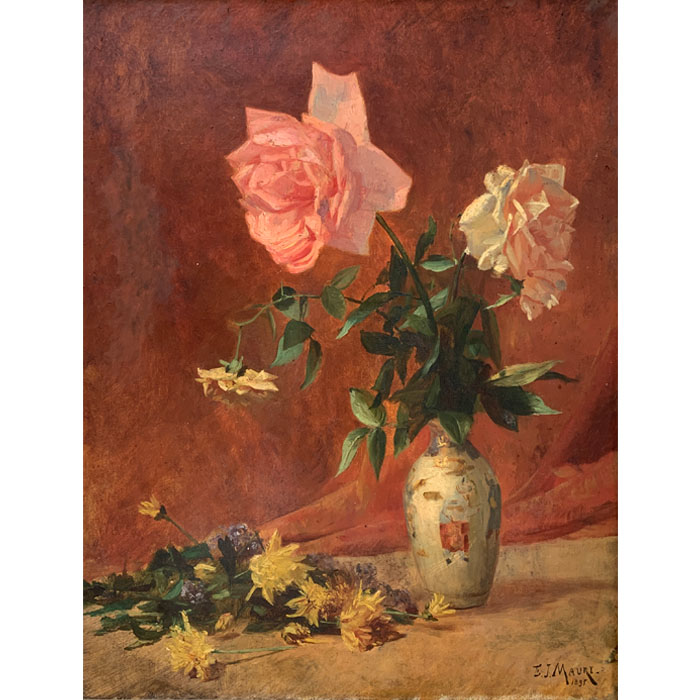
Emilio Jacinto Mauri Ivern was born on 9 March 1855 in La Guaira, Venezuela, the son of Juan José Mauri and Dorotea Ivern, parents of Spanish and French origin respectively. Around 1861, his family settled in Nantes, France, where he received his early education from Jesuit fathers and began medical studies at the local hospital, which he eventually abandoned to devote himself to painting. This early immersion in French culture and education would shape both his artistic formation and his later role as a transmitter of French academic models to Venezuela.
He moved to Paris as a young man and enrolled at the École des Beaux-Arts, studying under Jean-Léon Gérôme, and later at the Académie Julian under Jean-Paul Laurens; he also received private lessons in the workshop of Jacques Clément Wagrez. During his Parisian years he exhibited at the Salon, earning an Honorable Mention for his work Iris, and received a commission from the French Ministry of Public Instruction to restore the frescoes at the palace of the Marquis de Saint Paul. These European successes positioned him as one of the most academically trained Venezuelan artists of his generation.
In 1874, at the invitation of President Antonio Guzmán Blanco, Mauri returned to Venezuela to participate in the country's ongoing cultural reforms. He exhibited at the National Exposition of 1883, held to commemorate the centennial of Simón Bolívar's birth, where he won a bronze medal, and in 1893 he showed several canvases at the World's Columbian Exposition in Chicago. In 1887 he was appointed the first director of the newly founded Academia Nacional de Bellas Artes de Caracas, modeled after its French counterpart, a position he held until his death.
Mauri specialized in portraits, mostly of a historical nature, and is particularly remembered for his 1899 portrait of Luisa Cáceres de Arismendi, which brought him widespread recognition. As a teacher, he left a profound mark on Venezuelan art, counting among his disciples Federico Brandt, Manuel Cabré, and Antonio Edmundo Monsanto. Emilio Mauri died in Caracas on 18 February 1908, at the age of 52, leaving a legacy as a central figure in the institutionalization of academic painting in Venezuela.
We have access to a wide range of art collections to meet your requirements, ranging from Venezuelan & Latin American to international masters.
Contact us at +1 305 907-9960 regarding the artist you’re looking for; we’ll search and find it for you.
When starting a collection one must consider a variety of factors. First however, one must start by asking – why and how will I start to collect art?