



Bio
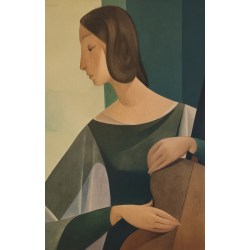
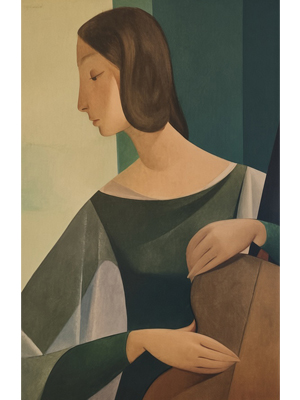 Armando Barrios was born in Caracas, Venezuela, in 1920, the son of Serapio Barrios and Carmen Rodríguez. He entered the Academy of Fine Arts in Caracas in 1932 and completed his studies between 1932 and 1937 at the Escuela de Artes Plásticas y Aplicadas, where his teachers included Marcos Castillo, Pedro Ángel González, Rafael Ramón González, Luis Alfredo López Méndez, and Antonio Edmundo Monsanto. His earliest creations belonged to the figurative tradition. In 1942 he received an honorable mention at the III Salón Oficial for La Niña En Azul, and in 1945 he presented his first solo exhibition at the Museo de Bellas Artes in Caracas, a selection of oils spanning a decade of work (1935–1945) that included El Flautista (1939), Los Caobos (1942), and a portrait of Vicente Emilio Sojo (1944). That same year, his work La Niña won the José Loreto Arismendi Prize at the VI Salón Oficial, and in 1946 he was awarded at the VII Salón Oficial for Tambores.
In 1949 Barrios traveled to Paris, where he studied at the Académie de la Grande Chaumière and frequented the Abstract Art Workshop directed by Jean Dewasne and Edgar Pillet. During this period his painting, which had been built on linear rhythms, moved decisively toward abstraction. He exhibited at the Casa de América Latina and at UNESCO in Paris, and in 1950 he participated in the activities of the group Los Disidentes and showed work at the Salon de Mai. The following year he published lithographs in Seis Prosas, a book by his wife, the poet Reyna Rivas, and took part in the VI Salon des Réalités Nouvelles; the Galerie de France also organized a showing of his most representative works.
Barrios returned to Venezuela in 1952, and the architect Carlos Raúl Villanueva commissioned him to create murals for the Ciudad Universitaria de Caracas, including a mural for the façade of the Estadio Universitario and another for the Plaza del Rectorado; he also made a mural for the Hotel Nueva Segovia in Barquisimeto. These works belong to his abstract-geometric phase. From 1954 he moved back toward figuration while retaining the rhythmic composition and flat structure of his abstract period. In 1956 he won the Antonio Esteban Frías Prize at the XVII Salón Oficial with Contrapunto, and in 1957 he received the National Prize for Painting at the XVIII Salón Oficial Anual de Arte Venezolano for a group of oils and pastels. He served as director of the Museo de Bellas Artes de Caracas between 1956 and 1958 and represented Venezuela at the Venice Biennale in 1956 and 1960.
Armando Barrios died in 1999. His work has been exhibited in France, the United States, South Korea, Spain, Italy, and Switzerland, among other countries. A 2019 exhibition in Madrid, Armando Barrios. Ars Poetica, brought together more than one hundred works, including paintings, set designs, and numerous sketches, most of them previously unexhibited. He is remembered as an artist who moved fluidly between figuration and geometric abstraction, and whose murals for the Ciudad Universitaria de Caracas form part of one of the most important architectural and artistic ensembles in twentieth-century Venezuela.

