



Bio
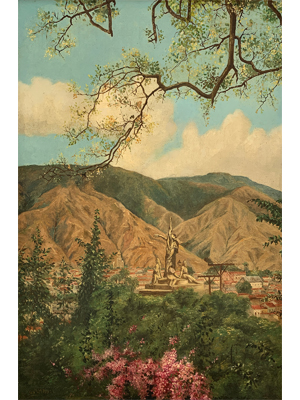
Gabriel D'Empaire was born in Maracaibo, Venezuela, on August 18, 1885, to Alejandro D'Empaire and Genoveva Troconis. In 1893, at just eight years old, he was sent to the Colegio Cedestrón in Curaçao, where he remained for a decade and completed his general education while becoming fluent in English, French, and Italian. In 1903, he traveled to Caracas to begin his artistic training, initially studying with a French artist surnamed Durban and later at the Academy of Fine Arts under the painter Antonio Herrera Toro. He was a standout student of Herrera Toro, who recommended him to Jesús María Herrera Irigoyen, the director of the prestigious magazine El Cojo Ilustrado.
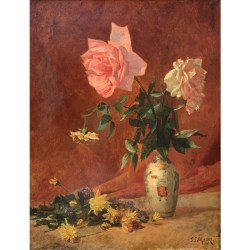
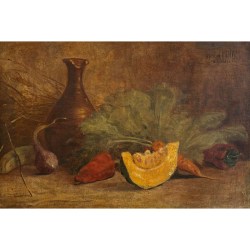
From approximately 1909 until the magazine's closure in 1915, D'Empaire worked as an illustrator for El Cojo Ilustrado, filling its pages with vignettes, figures, allegories, and reproductions of his own drawings. During this period, he also ran a painting and decoration workshop and produced murals for private homes, a common practice at the time for those who could not afford tapestries. In 1911, he married Carolina Estrada Montufar, a descendant of María Antonia Bolívar, with whom he had eleven children—ten daughters and one son. That same year, he dedicated himself fully to painting as a profession, producing landscapes, seascapes, still lifes, and, with particular insistence, roses.
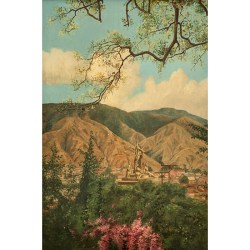
D'Empaire's artistic output was essentially academic in character, and he is especially remembered for his landscapes and seascapes, where his personal imprint is most clearly felt. His small-format works are noted for a precision of line that recalls photographic detail, with a delicacy so fine that it seemed painted with a single-hair brush. A deeply introverted and reclusive man, he never held a single exhibition, not even a collective one, and his work remained largely absent from public memory during his lifetime. He was a friend of Armando Reverón, who painted his portrait, though D'Empaire never identified with Reverón's artistic approach. He also copied works by Arturo Michelena, including La vara rota, Miranda en La Carraca, La joven madre, and Pentesilea—the latter commissioned by President Isaías Medina Angarita as a gift for Manuel Prado, the president of Peru.
In 1948, D'Empaire moved to Caraballeda, where he lived for about six years, devoting himself primarily to coastal landscapes and popular scenes. Though he was not a member of the Círculo de Bellas Artes, he eventually embraced its themes, and his work has been described as "valorist" in its handling of color. The Galería de Arte Nacional in Caracas holds two of his works in its collection: Paisaje del Ávila (oil on canvas) and Iglesia de San Francisco (oil on cardboard). Sources differ on the exact date of his death in Caracas in 1971—Wikipedia lists October 14, while other references cite October 10 or October 24—but he is consistently remembered as one of Venezuela's most notable "forgotten artists," a painter of exquisite technical refinement who chose a quiet life over public recognition.